
China’s Chang’e-5 Moon mission probe touches down
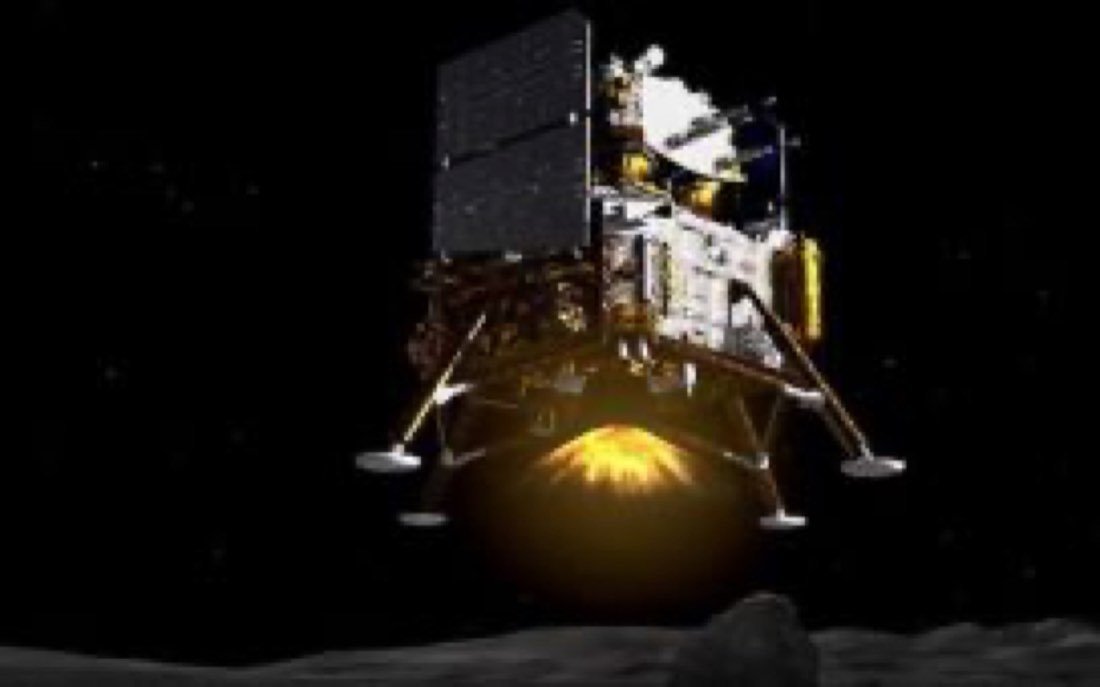
China has successfully put another probe on the Moon.
Its robotic Chang’e-5 mission touched down a short while ago with the aim of collecting samples of rock and dust to bring back to Earth.
The venture has targeted Mons Rümker, a high volcanic complex in a nearside region known as Oceanus Procellarum.
The lander is expected to spend the next couple of days examining its surroundings and gathering up surface materials.
It has a number of instruments to facilitate this, including a camera, spectrometer, radar, a scoop and a drill.
The intention is to package about 2kg of “soil”, or regolith, to send up to an orbiting vehicle that can then transport the samples to Earth.
It’s 44 years since this was last achieved. That was the Soviet Luna 24 mission, which picked up just under 200g.
Unlike the launch of the mission a week ago, the landing was not covered live by Chinese TV channels.
Only after the touchdown was confirmed did they break into their programming to relay the news.
The 8.2-tonne Chang’e-5 spacecraft “stack” was launched from the Wenchang spaceport in southern China on 24 November (local time). It arrived above the Moon at the weekend and then set about circularising its orbit before splitting in two.
One half – a service vehicle and return module – stayed in orbit, while a lander-ascender segment was prepared for a touchdown attempt.
The Chinese space agency said this lander-ascender element put down at 15:11 GMT (23:11 China Standard Time). The precise position was reported as 51.8 degrees West longitude and 43.1 degrees North latitude.
Chang’e-5’s success follows China’s two previous Moon landings – those of Chang’e-3 in 2013 and Chang’e-4 last year. Both of these earlier missions incorporated a static lander and small rover.
A total of just under 400kg of rock and soil were retrieved by American Apollo astronauts and the Soviets’ robotic Luna programme – the vast majority of these materials coming back with the crewed missions.